Monday, December 17, 2012

nb1 17/12/12


Homework: writing p 112 (Your favourite day) (The text is very difficult, do something easy, talk about your routines this special day and use frequency adverbs (sometimes, normally, always, never...) and time connectors (First , then, after that or after lunch / breakfast..., finally,...)

Fechas (dates)
ON 22nd September (On the 22nd of September – la parte en fosforito se lee pero no se escribe)
ON September 22nd (On September the 22nd– la parte en fosforito se lee pero no se escribe)
El número se lee siempre como ordinal, pero puede aparecer escrito como cardinal (22 en lugar de 22nd).


Ordinal Numbers from 1 through 1,000,000
1
st
first
11
th
eleventh
21
st
twenty-first
31
st
thirty-first
2
nd
second
12
th
twelfth
22
nd
twenty-second
40
th
fortieth
3
rd
third
13
th
thirteenth
23
rd
twenty-third
50
th
fiftieth
4
th
fourth
14
th
fourteenth
24
th
twenty-fourth
60
th
sixtieth
5
th
fifth
15
th
fifteenth
25
th
twenty-fifth
70
th
seventieth
6
th
sixth
16
th
sixteenth
26
th
twenty-sixth
80
th
eightieth
7
th
seventh
17
th
seventeenth
27
th
twenty-seventh
90
th
ninetieth
8
th
eighth
18
th
eighteenth
28
th
twenty-eighth
100
th
one hundredth
9
th
ninth
19
th
nineteenth
29
th
twenty-ninth
1,000
th
one thousandth
10
th
tenth
20
th
twentieth
30
th
thirtieth
1,000,000
th
one millionth


fortieth /ˈfɔːtiəθ/ UK  US  número
1 cuarenta, cuadragésimo -a
2 cuarentavo, cuarentava parte


PREPOSITIONS:

Hay que distinguir entre preposiciones de posición/lugar y de movimiento.
Los verbos de posición indican donde se desarrolla la actividad:
He is / studies / works /… in a library.

Por otro lado tenemos preposiciones de movimiento. El verbo GO va siempre seguido de la preposición TO excepto para “GO HOME”.

In an hour and a half ≠ In half an hour.

At midday.
AT lunchtime.


cafeteria /ˌkæfəˈtɪəriə/ UK  US  sustantivo
1 (en un colegio, una fábrica) comedor, cafetería
2 (en un lugar público) cafetería


fun /fʌn/ UK  US  sustantivo &  adjetivo
 •  sustantivo
1 to be fun ser divertido -a
to have fun divertirse
 •  adjetivo
divertido -a
a fun day at the beach
un día divertido en la playa
 ▶ fun es divertido en el sentido de entretenido, a diferencia de  funny que es divertido en el sentido de gracioso

the same to you

interesting /ˈɪntrəstɪŋ/ UK  US  adjetivo
interesante


vegetable /ˈvedʒtəbəl/ UK  US  sustantivo
1 verdura


fruit /fruːt/ UK  US  sustantivo (plural fruit o fruits)
1 fruta
I eat a lot of fruit.
Como mucha fruta.

menu /ˈmenjuː/ UK  US  sustantivo
1 (en un restaurante) carta
the most expensive dish  on the menu
el plato más caro de la carta


T-shirt /ˈtiː ʆɜːt/ UK  US  sustantivo
Camiseta (in p.28 the pronunciation is wrong)

I go to the market to buy food for the restaurant.
To + verb (para)
For + noun (para)


I walk to work
I go to work on foot / walking
I drive to work
I go to work BY car / bus / train ...

Me too (yo tb) ≠ Me neither.

cocoa /ˈkəʊkəʊ/ UK  US  sustantivo
1 cacao
2 chocolate [bebida]

unemployed /ˌʌnɪmˈplɔɪd/ UK  US  adjetivo
en el paro, desempleado -a
She's unemployed.
Está en el paro.

Thursday, December 13, 2012

ni2 13-12-12


Write three sentences comparing two similar objects using the phrases on p.43 listening activity, part B.

USED TO:

I’m used to getting up at 5:00 (to be accustomed to the situation)
I got used to working at night (to become accustomed).

(past) I used to go to school by bus.
(present) I use to go work by bus.
                I usually go to work by bus.

Shoppaholic

be/stand/wait in a queue
We stood in a queue for half an hour.
You'll have to join the queue.

The Spanish word “naturaleza” can be tanslated as:
In the countryside / wild / country.


gorgeous /ˈgɔːdʒəs/ UK  US  adjetivo (informal)
 divino -a, precioso -a


tacky /ˈtæki/ UK  US  adjetivo (-ckier, -ckiest) (informal)
1  hortera, chabacano -a
2 cursi

weave1 /wiːv/ UK  US  verbo (pasado wove, participio woven)
1  [transitivo] tejer [en un telar]
2  [transitivo] entretejer


bargaining /ˈbɑːgɪnɪŋ/ UK  US  sustantivo
1 negociaciones
2 regateo

uneven /ʌnˈiːvən/ UK  US  adjetivo
1 irregular, desigual [superficie]
2  irregular [respiración, distribución]

upgrade /ˈʌpgreɪd/ UK  US  sustantivo
actualización [en informática]

a better deal
on the whole
store
.. as well
we can match that

A nose job

Wednesday, December 12, 2012

nb1 12/13-12-12


Homework: reading p. 30-31 ex. 3 + Grammar Bank 4B p. 131

Whose...? : de quién...? (preguntamos siempre por el poseedor de 1 o + objetos)
Whose pencilcase is this? This/It is Peter’s (pencilcase)
Whose pencils are these? They/these are Peter’s (pencils) ← cuando pongo algo entre paréntesis es porque podéis ponerlo o no, es opcional.
El objeto por el que preguntas puede ir inmediatamente tras la partícula “whose” o al final de la pregunta)
Whose is this pencilcase?
Whose are these pencils?

Por pronunciación puede confundirse con “Who’s” pero por estructura y contexto se diferencian perfectamente.

Who’s the man in the car? (Preguntas por  la identidad de 1 persona) He’s my uncle.
Whose car is this? (preguntas por la persona que posee algo) It’s my uncle’s.

smartphone /ˈsmɑːtfəʊn/ sustantivo
smartphone, teléfono inteligente

Boyfriend – girlfriend
She does her hair for free.

half /hɑːf/

walk /wɔːk/
walk the dog / take the dog for a walk

I get up AT seven

Go cycling
I go mountain biking

I surf the net
A white coffee.
A black coffee.
A latte and a biscuit.
I go to work BY car.
I go home and have lunch.
Do the shoping.


cafeteria /ˌkæfəˈtɪəriə/ UK  US  sustantivo
1 (en un colegio, una fábrica) comedor, cafetería
2 (en un lugar público) cafetería


All right
Wake up (despertarse) ≠ get up (levantarse)
I go for a walk to the park.
I study with my son.
Have lunch.
After that, I ...
Look for a job.
Once/Twice/three times/four times ... a week.
Classmates.
On Mondays and ...
For a while.

hour /aʊə/
a piece of toast.


mobile phones


video about the family:
http://australianetwork.com/studyenglish/s2922759.htm

Tuesday, December 11, 2012

ni2 11-12-12


Homework: vocabulary p. 41 + writing p.32 workbook 150 – 200 words.

Get along – to have a friendly relationship

Worst jobs in history

largely /ˈlɑːdʒli/ UK  US  adverbio
en gran parte/medida


guinea pig /ˈgɪni pɪg/ UK  US  sustantivo
conejillo de Indias

trial /ˈtraɪəl/ UK  US  sustantivo
1 juicio
to be on trial (for sth) estar siendo procesado -a (por algo)
2 prueba
clinical trials
pruebas clínicas


cramped /kræmpt/ UK  US  adjetivo
1 reducido [espacio]
cramped conditions falta de espacio
2 to be cramped estar apretado -a
We're a little cramped in here.
Estamos un poco apretados aquí.


arrive /əˈraɪv/ UK  US  verbo [intransitivo]
1  llegar
When we  arrived at  the house, no one was in.
Cuando llegamos a la casa, no había nadie.
She  arrived in  Miami at 3 p.m.
Llegó a Miami a las 3 de la tarde.

used1 /juːst/ UK  US  adjetivo
to be used to (doing) sth estar acostumbrado -a a (hacer) algo
We're used to getting up early.
Estamos acostumbrados a levantarnos temprano.
to get used to (doing) sth acostumbrarse a (hacer) algo
I'll have to get used to walking to work.
Tendré que acostumbrarme a ir andando al trabajo.
 ▶ No confundir con el verbo modal used to. Ver más abajo

Monday, December 10, 2012

nb1 10-12-12


Homework: grammarbank 4A (a, b + c) p.131.

I would like...
Here you are.
A piece of cake.
To have here
To take away
A white coffee
At midnight
At midday


Mary’s car
Mary’s daughter.


husband /ˈhʌzbənd/ UK  US  sustantivo
marido, esposo
Dad(dy) – grand(d)ad – grandpa.
Mum(my) – grandma – granny.
Grandchildren- grandson – granddaughter.

cousin /ˈkʌzən/ UK  US  sustantivo
primo -a
first cousin primo -a hermano -a
second cousin primo -a segundo -a

Who is he/she?
He/She’s ______’s _______. (He is Richard’s son).


whose /huːz/ UK  US  adjetivo & pronombre
1 (en preguntas directas e indirectas) de quién

celebrity /səˈlebrəti/ UK  US  sustantivo (plural -ties)
famoso -a, celebridad


Whose car is this?/ Whose is this car?
¿De quién es este coche?
Whose shoes are these? / Whose are these shoes?
¿De quién son estos zapatos?
Whose …? – De quién...?
Whose car is this? It’s Peter’s (car).
Whose are those pens? They are Peter’s.

Who’s…? – Quién es…?
Who’s (is) Peter? He is my cousin.
Who are they? They are my aunt and uncle.


My people’s class (irregular plural)
My students’ class (pl)
Andres’s book (sg)

Plural of nouns with an “f” in them.
Life (sg) – lives (pl) (vida)
Wife – wives (mujer)
Leaf – leaves (hoja)
Knife – knives (cuchillo)


Would you like … (an espresso)?

thanks /θæŋks/

much /mʌtʆ/

anything /ˈeniθɪŋ/

away /əˈweɪ/

here /hɪə/

large /lɑːdʒ/

regular /ˈregjʊlə/

single /ˈsɪŋgəl/

would /wʊd/

help /help/

you /jə, jʊ, acentuado juː/

/helpjuː/

Can you help me / you/ him/ her/ it/ us/ you/ them?

take-away food

a.m., A.M. /eɪ ˈem/ UK  US
de la mañana
We open at 9 a.m.
Abrimos a las 9 de la mañana.
 ▶ El reloj de 24 horas se usa menos en inglés que en español. Es más frecuente el uso de a.m. y p.m.

water /ˈwɔːtə/
 •  sustantivo
agua
Can I have a drink of water, please?
¿Me das un poco de agua, por favor?

jealous /ˈdʒeləs/ UK  US  adjetivo
1 envidioso -a
to be jealous of sth tener envidia de algo, envidiar algo
to be jealous of sb tenerle envidia a alguien
2 celoso -a
He  gets jealous  if I go out with my friends.
Se pone celoso si salgo con mis amigos.

Tuesday, December 04, 2012

ni2 4-12-12


Homework: p. 144 ((don’t) have to, can + allowed to/supposed to) + reading act. P. 40 ( a, b, c, d, e, and f)
Long weekend is a term used in Western countries to denote a weekend that is at least three days long (so, a "three-day weekend"), due to a holiday falling on either the Friday or Monday.

bank holiday [countable]
British English an official holiday when banks and most businesses are closed [= public holiday American English]
Next Monday is a bank holiday.

Four-day weekend

So to say/speak
if one may use such an expression; in a way; it could be said: The dog is, so to speak, a member of this family.

have two left feet
informal to be very clumsy

compulsory /kəmˈpʌlsəri/ UK  US  adjetivo
 obligatorio -a


vet 1 /vet/

optician /ɒpˈtɪʆən/ UK  US  sustantivo
óptico -a (optometrista)

firefighter /ˈfaɪəfaɪtə/ UK  US  sustantivo
bombero -a

guard 1 /ɡɑːrd / || /ɡɑːd/

ˌfirst ˈaid UK  US  sustantivo
primeros auxilios

clue /kluː/ UK  US  sustantivo
1 (para esclarecer un misterio, etc.) pista
There are no  clues to  the killer's identity.
No hay pistas sobre la identidad del asesino.

3 not to have a clue (informal) no tener (ni) idea, no tener (ni) la menor idea

in the wild

impractical /ɪmˈpræktɪkəl/ UK  US  adjetivo
 poco práctico -a


reprimand /ˈreprɪmɑːnd/ UK  US  verbo & sustantivo
 •  verbo [transitivo]
reprender
 •  sustantivo
reprimenda

sick leave [uncountable]
time that you are allowed to spend away from work because you are sick
on sick leave
He has been on sick leave for more than three months.

at short notice
British English, on short notice American English if you do something at short notice, you do not have very much time to prepare for it:
The trip was planned on short notice.
Thanks for agreeing to see me at such short notice.
a cancellation at very short notice

trade union also trades union [countable] British English
an organization, usually in a particular trade or profession, that represents workers, especially in meetings with employers [= labor union American English]

Monday, December 03, 2012

nb1 3/4-12-12


Homework: p. 28 exercise 2 (a + b)

How much ____ (uncountable noun (e.g. money) )_____ do you _____(verb (e.g. have) )____?
How much money do you have?
How many ____ (countable noun (e.g. cars) )_____ do you _____(verb (e.g. have) )____?

How many cars do you have?
What kind of ____ (noun (e.g. music) )___ do you ___ (verb (e.g. like) )___?
What kind of music do you like?

What's your job?
What do you do?


I have sweet tooth...

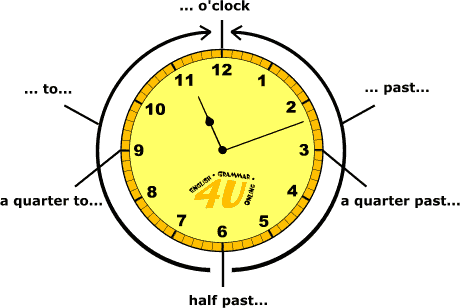
Telling the time:

quarter /ˈkwɔːtə/
2 (en expresiones de tiempo

It's a quarter to two/three etc BrE , quarter of two/three etc AmE las dos/tres etc menos cuarto

It's a quarter past two/three etc BrE , quarter after two/three etc AmE las dos/tres etc y cuarto
half /hɑːf/ UK  US  
2 half past one/two etc la una/las dos etc y media
It’s half past three
Son las tres y media

/əˈklɒk/ UK  US  adverbio

O'clock /əˈklɒk/ UK  US  adverbio
It's two/three etc o'clock las dos/tres etc


What’s the time? = What time is it?

Good to meet you.

meeting /ˈmiːtɪŋ/ UK  US  sustantivo
1 reunión
She's in a meeting.
Está en una reunión./Está reunida.
I'd like to  have a meeting  with them.
Me gustaría tener una reunión con ellos.

Lots of time = a lot of time


menu /ˈmenjuː/ UK  US  sustantivo
1 (en un restaurante) carta
the most expensive dish  on the menu
el plato más caro de la carta
2 (en informática) menú

caf‧fé lat‧te [uncountable and countable] coffee and hot milk
latte / ˈlɑːteɪ/ , / ˈlæteɪ/
brownie


How much ($$$$) is it?
White or black coffee?
es‧pres‧so plural espressos [uncountable and countable]
strong black Italian coffee, or a cup of this coffee

croissant /ˈkwɑːsɒŋ, AmE krwɑːˈsɑːnt/ UK  US  sustantivo
croissant


to be early ≠ to be late

Do exercise

When do you do exercise?
They decide to have a coffee.
cap‧puc‧ci‧no  plural  cappuccinos [uncountable and countable]
Italian coffee made with hot milk and with chocolate powder on top

I don’t drink anything.
I drink nothing

Remember that in English, we divide prices at the decimal point.
For example:
$4.59
four dollars (and) fifty-nine cents

four / fifty nine
(long way)

(short way)